By NOI Coworking Medellín on
A 60-minute hybrid meeting closes decisions: it avoids six minutes lost
A 60-minute agenda structures discussion, includes remote participants, and documents clear owners and dates for each decision.

A decision meeting that starts late often ends without a clear close. Owl Labs’ State of Hybrid Work 2025 reports an average delay of more than six minutes at the start of hybrid meetings, while 77% of surveyed workers lost time to technical issues. An NOI workspace in Medellín needs, above all, a sequence that protects decision time.
The point is not to fill an hour with conversation, but to leave with a decision, an owner, and a date. That structure is useful for teams alternating between onsite and remote work; Colombia’s Law 2466 of 2025 describes hybrid telework as two or three weekly days at home and the rest at the employer’s physical facilities.
For someone arriving in Ciudad del Río just for the session, a coworking desk for the day can separate individual preparation from the group conversation. Duration and format still depend on the decision at hand and the number of participants.
What is a 60-minute agenda for a hybrid decision meeting?
The hour works when it is divided into context, discussion, choice, and closing, with one person protecting time and another recording the outcome. The final ten minutes should leave an explicit decision, an owner, and a date. This agenda is not a legal requirement or a formula for every conversation; it fits a meeting meant to choose a path, not simply share updates.
- 0–5 minutes: join, run a brief audio check, and confirm the decision to be made.
- 5–15 minutes: share common context, essential facts, and the criteria for assessing each option.
- 15–40 minutes: discuss in turns; remote participants speak before a new in-room round begins.
- 40–50 minutes: narrow the options, vote or seek consent, and state the decision.
- 50–60 minutes: record tasks, owner, date, and the document that will track follow-through.
How can remote participants take part and vote?
Remote participation improves when questions, turns, and votes have a visible shared channel instead of relying on someone interrupting from a screen. A case study from IEEE/ACM CHASE 2025 found that active discussion and brainstorming benefit from being together, while mass information sharing can work at a distance.
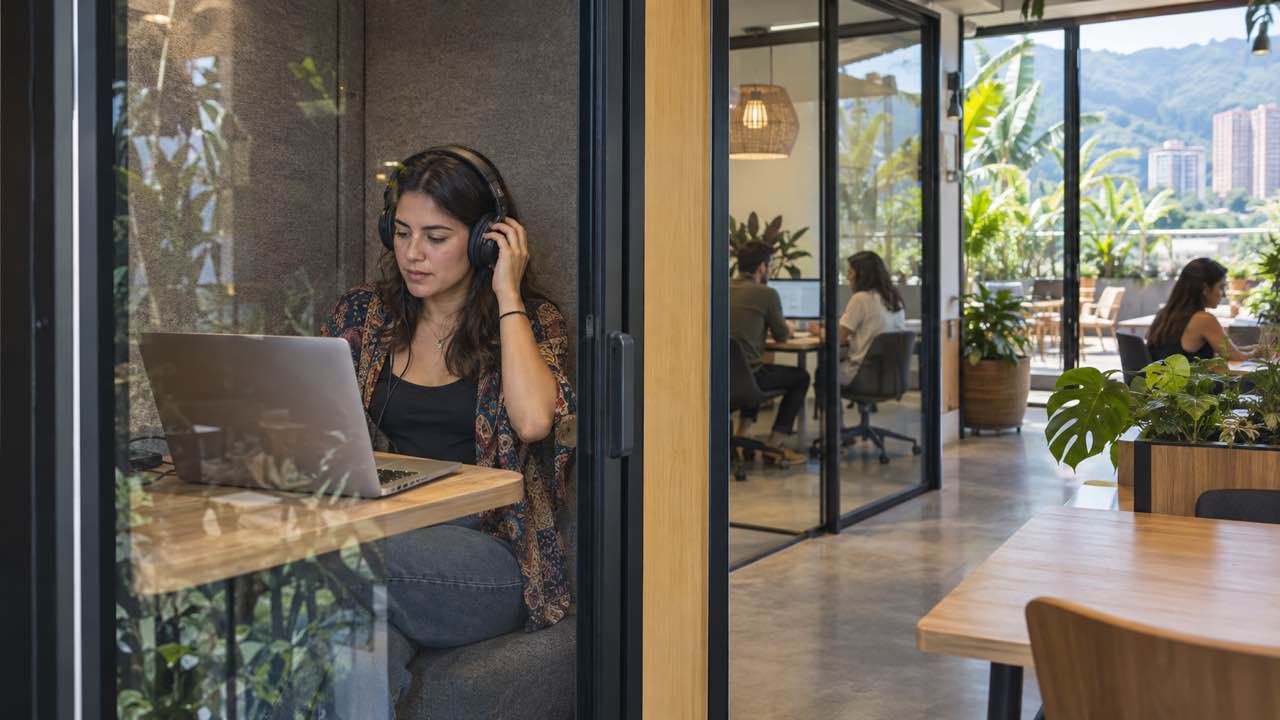
Professional tests audio before a hybrid meeting. Illustrative image generated with artificial intelligence.
That does not require everyone to be in the same place. It does make it important to agree on how remote colleagues will be heard, how material will be seen, and how votes will be counted. A private office may offer more continuity to a small group needing several confidential conversations; its fit depends on the project’s frequency and confidentiality.
What should be tested before the meeting starts to avoid lost time?
A short check of connection, camera, audio, access link, and working file prevents the opening minutes from being spent on basics. It also clarifies who will share their screen and who will take notes. The check works when it mirrors actual participation: voices in the room and voices joining remotely.
The invitation is stronger when it states the objective, expected decision, and documents to read beforehand. Generative artificial intelligence can summarize background or draft an outline, but a 15-study review published in Procedia Computer Science found negative effects on choice tasks; the team retains the decision.
What should be documented when the meeting closes?
The close records one sentence on the decision, the criteria behind it, the tasks, their owners, and agreed dates. If a disagreement remains unresolved, it is recorded with its next step rather than presented as agreement. That brief record lets someone joining remotely confirm the same outcome heard in the room.

Agreements, owners, and dates written down at the end of a meeting. Illustrative image generated with artificial intelligence.
When meetings recur during the month, a coworking ticket package may fit concentrated use better than a permanent commitment. If the team needs a daily base, a permanent desk or a private office meets different needs for continuity.
Where can a hybrid team reserve meeting rooms in Medellín?
A reservation is best defined by the kind of decision, the number of people, and remote participation—not room size alone. NOI Coworking, in Ciudad del Río, has rooms for 6, 10, and 14 people. Availability, included equipment, and booking conditions depend on the date and requested service, so those details are confirmed directly when booking.
The local context also calls for meetings that do not dissolve into loose comments: on September 11, 2026, Ruta N reported the selection of 50 startups for Medellín Next’s third cohort. That does not describe how those companies work, but it does underline that as a team grows, one hour with a clear close matters more than a meeting that merely gathers comments.