By NOI Coworking Medellín on
A dedicated desk organizes daily work: the company’s obligations remain
A stable work base can simplify the day without making the workspace responsible for the company’s own obligations.

A personal desk away from home often stops being a preference when the workday loses time to small decisions: where to take a call, where to leave a computer, or how to receive a visitor. The signal is not working longer hours, but repeating frictions that a stable base can remove.
In Medellín, the supply of conventional offices has tightened: JLL reported 3.7% office vacancy in the first half of 2026, down from 4.6% at the end of 2025. That context makes it useful to separate the need for one person’s workspace from the larger decision to lease and fit out a full office.
A dedicated desk is an assigned desk for recurring use within a shared workspace. At NOI in Ciudad del Río, that base comes alongside secure 24/7 access, high-speed internet, soundproof call booths, ergonomic furniture, coffee, mail reception, bicycle parking, and a pet-friendly policy.
This decision does not replace a company’s responsibilities toward its people. It can solve everyday infrastructure; the contract, equipment, occupational safety and health, and the terms of each employment relationship still require their own review.
A dedicated desk?
A dedicated desk makes sense when work needs a consistent operating address but does not yet require an exclusive office. The key difference is the permanence of the workplace, not an automatic promise of compliance or savings. A useful comparison starts with the actual routine: presence, calls, visitors, equipment, and documentation.
Which frictions show that a stable base is now needed?
The first appears when setting up the day takes time every morning. Carrying chargers, seeking quiet for confidential conversations, or improvising a comfortable surface turns the workplace into another task. A soundproof booth is an enclosure designed to reduce call noise; it does not replace internal protocols for sensitive information.
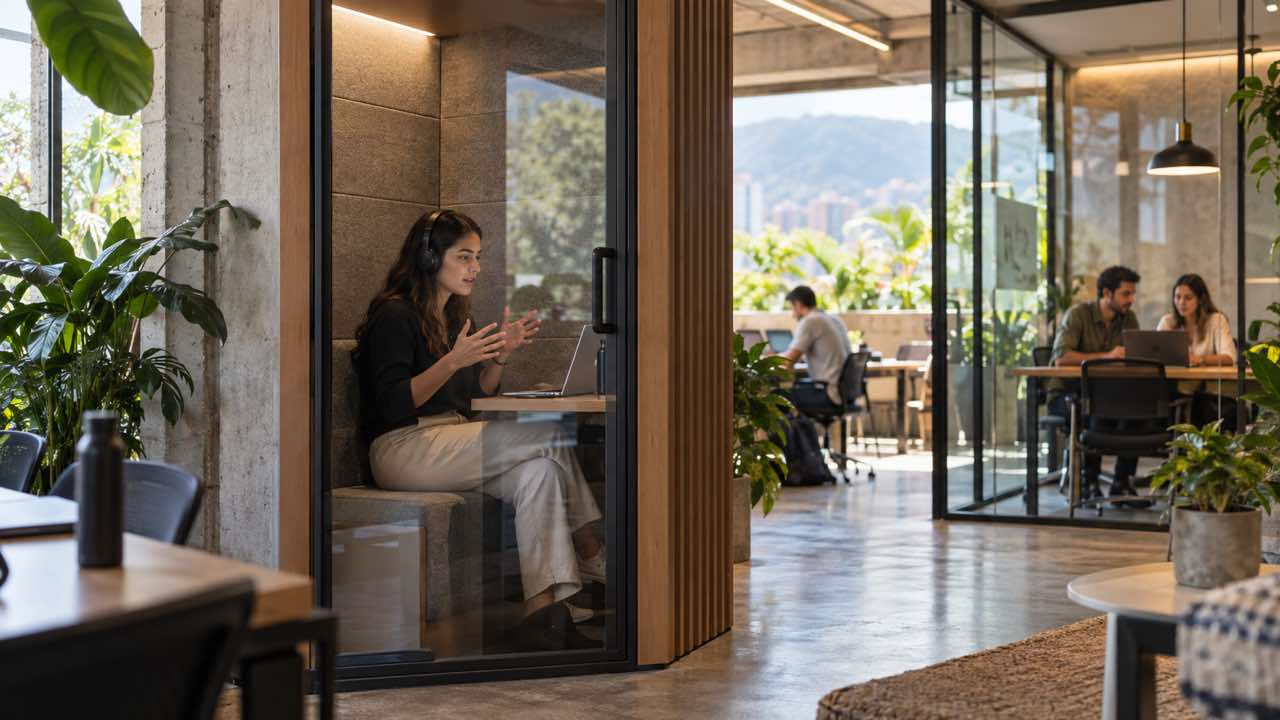
Professional takes a video call inside a soundproof booth. Illustrative image generated with artificial intelligence.
The second appears when a professional alternates between home, cafés, and borrowed rooms but needs to keep materials or a monitor-and-chair setup. An assigned desk reduces daily packing and unpacking and lets the workspace feel more like a station than a bag.
- Frequent video calls require quiet and a consistent connection.
- The workday depends on peripherals, paper documents, or a working posture that should not be rebuilt every day.
- Clients, suppliers, or colleagues need a predictable meeting point.
- Working hours vary, and a conventional workday does not cover every needed hour.
How does it compare with leasing a conventional office?
The comparison starts with scale. A conventional office concentrates square footage, fit-out, and administration in a dedicated lease; a dedicated desk focuses the need on one or a few people. Neither format is automatically the better value: the answer changes with team size, use time, and the services actually required.
The office market helps explain why that distinction matters. Colliers recorded 11,396 m² of positive net absorption in Medellín in the third quarter of 2025 and noted a preference for modern buildings; JLL reported average rents per square metre, not comparable desk rates. Therefore, JLL’s office indicators are context, not a coworking quote.
There is also no universal price for a dedicated desk. Commitment length, included services, number of people, and access requirements change the cost. A current quote makes it possible to compare the monthly amount with the expenses that the operation would otherwise cover separately, without turning market averages into a promise. It also identifies what belongs to the workspace and what belongs to shared services, a useful distinction when alternatives have different scopes.
Which responsibilities do not change when using a coworking space?
For a company, contracting workspace does not by itself transfer its employment duties. Colombia’s Law 2121 of 2021 sets obligations for remote work —a regulated arrangement performed away from the usual site— regarding tools, equipment, connections, software, electricity, and internet; the terms must be defined in the contract. A dedicated desk can provide infrastructure, but it does not replace those definitions.

Two colleagues review documents in a coworking meeting room. Illustrative image generated with artificial intelligence.
The same applies to the Occupational Safety and Health Management System. Resolution 0312 of 2019 defines minimum standards for that system; the company retains its duty to manage its risks and obligations. Law 2121 as published by Función Pública can inform a contract review, which should be assessed by each organization’s employment and safety leads.
What is useful to make clear before contracting?
A useful commercial conversation grounds the use case before the label. It is helpful to set out in writing who will use the desk, access hours, included services, mail handling, and rules for visitors, pets, and equipment. Clarity prevents assigning the workspace responsibilities that are not part of the service. It also helps anticipate whether a meeting room, private office, or day-use option better covers occasional operational moments.
When the operation needs a consistent place without taking on an exclusive office, the next step is to review the terms of a dedicated desk in Ciudad del Río. The discussion can begin with the routine and the number of people rather than a generic rate, defining whether a stable base resolves the friction that keeps recurring. It also makes visible which requirements belong to the service and which must remain managed within the organization.