By NOI Coworking Medellín on
Four rain reports in Medellín this September despite a forecast of few: the plan B is decided in the final hours
An open-air event depends on a close forecast, a decision time and clear messages for attendees and suppliers.
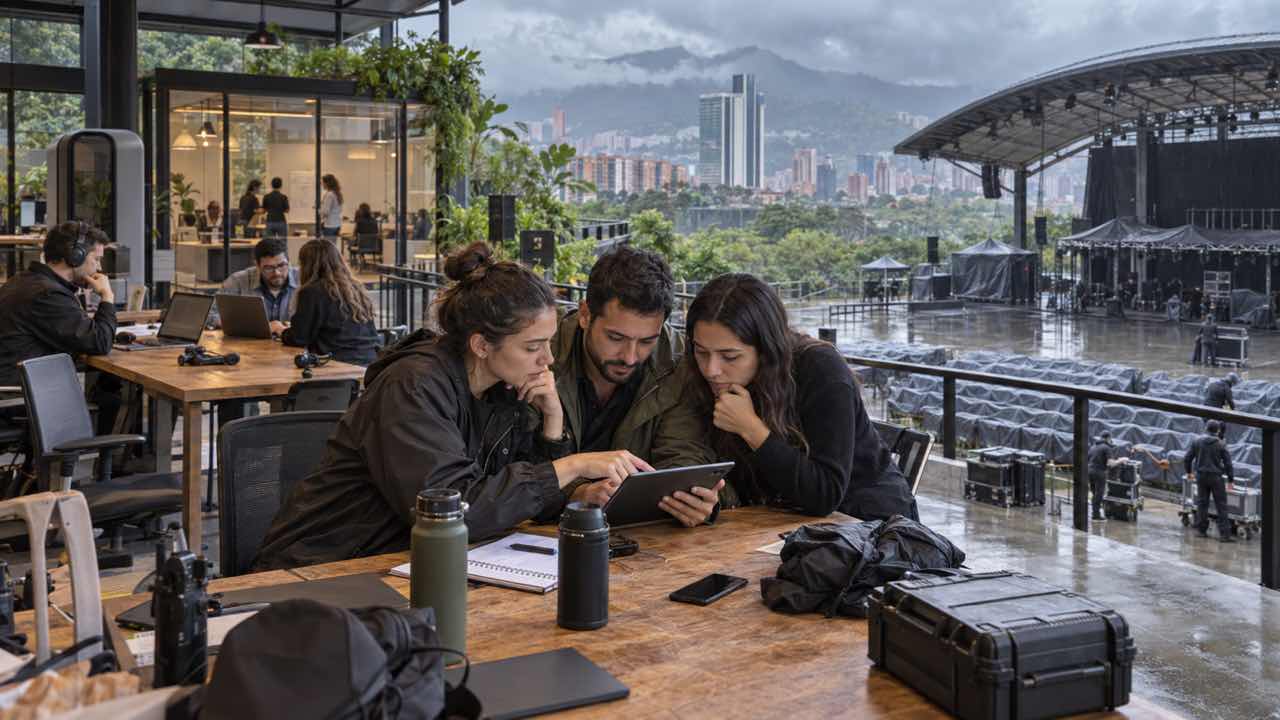
A season expected to bring less rain than usual does not settle an outdoor-event decision. Operations change with conditions in the hours before doors open. In September, SIATA logged rainfall reports in Medellín and the Aburrá Valley on September 1, 9, 10 and 20, even as the seasonal outlook pointed to below-normal rainfall.
The open-air theater for events in Ciudad del Río can host an outdoor gathering, but a backup should never be assumed. Availability for a move, an indoor space or a cancellation depends on what is agreed with the venue. That condition is best documented before invitations go out.
The useful reference is not a monthly forecast but the status closest to the event. IDEAM's daily technical report combines recent conditions and a forecast for the next 24 hours. Together with SIATA reports, it helps set a specific time to keep or change the setup.
How can a corporate event have a rain plan B?
A plan B works when it defines a real alternative, who decides and when the change is communicated. The plan should separate people’s safety, program continuity and equipment protection. A canopy, a pause, a move or a reschedule do not produce the same outcome or require the same resources.
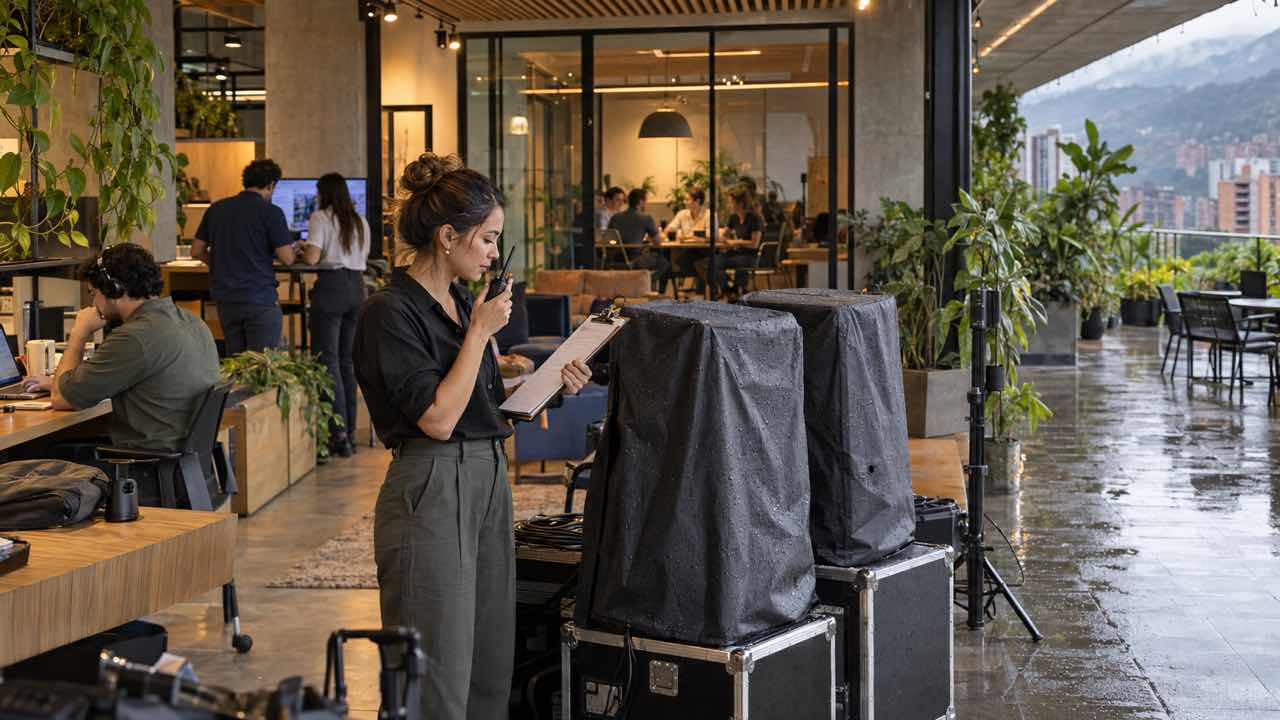
Coordinator checks contacts beside equipment protected from rain. Illustrative image generated with artificial intelligence.
- Decision time: a defined moment to review the forecast and venue conditions.
- Decision owner: one person authorized to confirm the change.
- Operating alternative: which parts of the program continue, pause or move.
- Equipment protection: who secures sound, screens, cabling and furniture.
What should be decided before an open-air event opens?
Before opening, the central decision is whether people can arrive, stay and leave safely while the program remains meaningful. Opening time needs a different criterion from the initial booking date. In April 2026, Medellín reported 487 rain-related emergencies, mostly landslides, fallen trees and flooding, according to the Medellín Mayor’s Office.
- Access and exit: attendee, supplier and equipment routes in rain.
- Minimum program: content that remains valuable if time is shortened or interrupted.
- Setup and teardown: the sequence for stopping work and protecting materials without improvising.
- Backup contact: ready phone numbers and messages for production, attendees and suppliers.
When is it sensible to move a corporate event indoors?
A move makes sense when the indoor alternative preserves the main objective and is confirmed, rather than merely imagined. A decision meeting, presentation or workshop may need different conditions from an open gathering. For smaller groups, a meeting room may work; for production work before or after, a coworking desk for a day can separate the production team.
The change also affects commitments already sent: setup, guests, schedules and suppliers. There is no single rule for when to move an event because risk and format vary by project. Confirming the available space, its capacity and its terms prevents announcing a solution that cannot later operate.
What should a rain contingency plan include?
The plan’s contents depend on the activity and on guidance from the competent authority. Business meetings and public performing-arts events do not necessarily face the same requirements. For complex public gatherings, Law 1801 of 2016 contemplates an emergency and contingency plan with risk analysis, evacuation, public information and necessary resources; the specific application varies with the event classification.

Team prepares plan-change messages inside an office. Illustrative image generated with artificial intelligence.
Where the activity is a public performing-arts event, Decree 1276 of 2020 includes the effects of natural events on infrastructure within these plans. The event’s legal classification determines whether that rule applies and what must be filed. The organizer and authority determine this, not the venue alone.
How should attendees and suppliers be told about a rain change?
Communication works when each group receives a different message before travelling. An early notice reduces arrivals at a setup that has already changed. The attendee message should state time, access and program; the supplier message should specify setup, delivery, equipment and the decision contact.
A contact list and two prepared versions—original plan and alternative—shorten the response when conditions change. A booking is clearer when its agreement defines how updates are communicated and who handles each adjustment. If the team needs to spread preparation across several days, a coworking pass bundle or a private office can provide a work base separate from the event.